What is Vasthaul?+
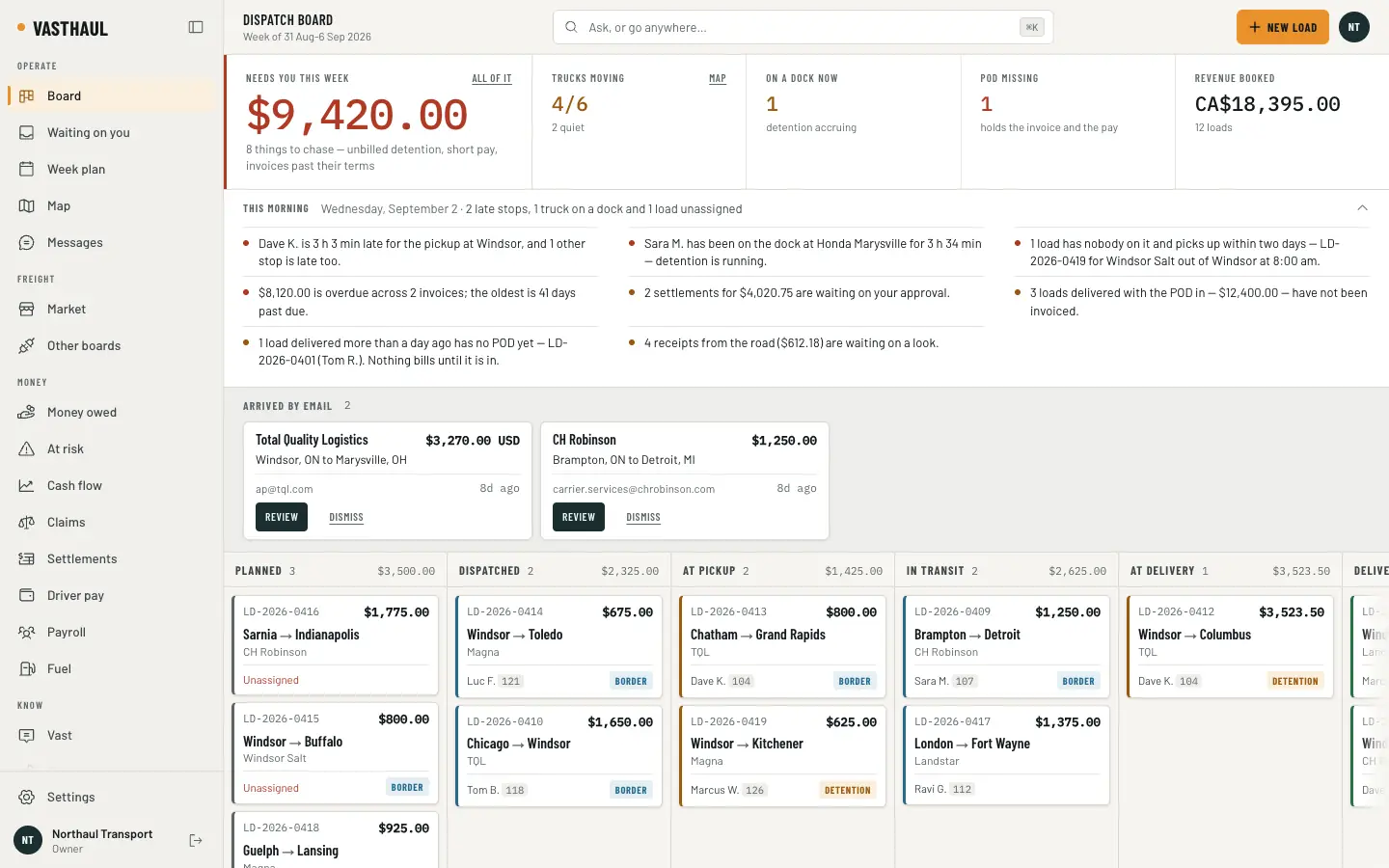
Vasthaul is a transportation management system — a TMS — for trucking carriers in the United States and Canada, at any fleet size: twenty trucks or five hundred. One record carries a load from the rate confirmation through dispatch, the driver's phone, the invoice to the customer and the driver's settlement, so the same figures are used all the way through.
Is this a TMS or trucking dispatch software?+
Both words describe it. Carriers shop for trucking dispatch software and end up needing invoicing and driver pay a month later, which is when a dispatch tool becomes three tools. Vasthaul is one: dispatching, invoicing, settlements, compliance and fuel records on the same load.
What does it cost?+
Seven published plans, priced per fleet in US dollars: Solo, $149 a month for 1–4 trucks; Starter, $399 a month for 5–10 trucks; Professional, $799 a month for 11–25 trucks; Complete, $1,100 a month for 26–75 trucks; Fleet, $1,900 a month for 76–150 trucks; Regional, $3,400 a month for 151–300 trucks; Enterprise, $5,900 a month for 301+ trucks. Every plan starts with a 14-day free trial, no card to start. Onboarding is estimated for your fleet on every plan and never a published figure: it depends on how much you bring — trucks, drivers, customers, pay rules, the spreadsheet you run on today — and it may be waived. There is no per-user fee and no fee per load, so a busy month costs the same as a slow one. The top plan has no truck ceiling, so a fleet that grows moves up a band rather than off the price list.
Is there a free trial?+
Yes — fourteen days of the whole product on every plan, with no card to start. Add a card when you are ready and it is not charged until the trial ends; cancel before then and it is never charged. If you let the trial run out without one, new loads wait until a card is on file, and everything you entered stays yours to read and export. You get a note in the product at seven, three and one day(s) out, and one email at three.
What makes it different from the other TMS we are looking at?+
Four things. One load record instead of modules that have to be kept in step. A flat price per fleet rather than per seat. Canada in the product from the first migration — CVOR, NSC, CVIP, kilometres, GST and HST — not a currency toggle. And software that drafts and flags but never books, sends, pays or files: Vasthaul prepares, a person approves.
We are a freight broker — can we use it?+
Not as your TMS, and we would rather say that than take your money. A broker is not a carrier with no trucks: you need a file on every carrier you use with their authority and insurance on it, rate confirmations that go out rather than come in, what you owe each carrier and when, and the margin on every load. None of that is built. What is built is the Vasthaul market: say you are a broker on the sign-up screen and you get a posting workspace — post a load, read the offers with each carrier's FMCSA record beside them, accept one, and follow it on the tracking link. No commission is taken today, and we will come to you first when the rest is built.
Can an owner-operator use it?+
Yes, and there is a price for it: $149 a month for one to four trucks, after the same 14-day free trial every plan gets. It is the same product a fifty-truck fleet runs on, not a cut-down version — your own settlement built from your own pay rules, the driver app on your own phone, invoices with the POD attached, and the border on the load. Setting it up is usually a spreadsheet you upload rather than a week of somebody entering things, which is why onboarding for one truck is estimated rather than listed, and is often waived.
We are a dispatch service — how does that work?+
Each carrier you dispatch for opens their own account and invites you as a dispatcher, and one login holds all of them. All carriers is the desk across the lot: what is late, what has nobody on it, what is sitting on a dock, at every carrier at once, with the carrier on every row — and one press takes you into whichever needs you, with the whole product for that carrier. What you will not get is a merged board. Two carriers’ loads in one column is a mistake we fixed rather than a feature we are missing, so the desk adds nothing up across carriers and carries none of their money.
Does it do IFTA?+
It calculates the quarterly return. Every load’s miles are split at the state and province lines from the truck route it was measured on, your fuel-card purchases are already recorded by the jurisdiction they were bought in, and the worksheet comes out with the miles, the fuel, the fleet average, the tax or the credit for each jurisdiction and the total — at the rates IFTA published for that quarter, which refuse to compute if the quarter is not loaded rather than quietly using the last one. Print it, export it, hand it to your bookkeeper. It does not file the return and it does not pay the tax: you file with your base jurisdiction, and a load with no measured route is listed by number so you can fix it rather than being estimated.
US or Canadian dollars?+
US dollars, in both countries, so the price on this page is the price on the statement. A Canadian carrier sees the equivalent beside it at the Bank of Canada rate; the card issuer's rate on the day is the one that applies.
Is it really not priced per user?+
No, and it is not priced per load either. The price is per fleet, by truck count. Add a dispatcher, an accountant, or ten drivers and the bill does not change; haul twice as many loads next month and the bill does not change. Add trucks and eventually you move up a band, which is the only thing that changes it. Several systems in this market bill by included shipments with overages above them, which charges a carrier more in a good month.
Do my drivers have to install something from an app store?+
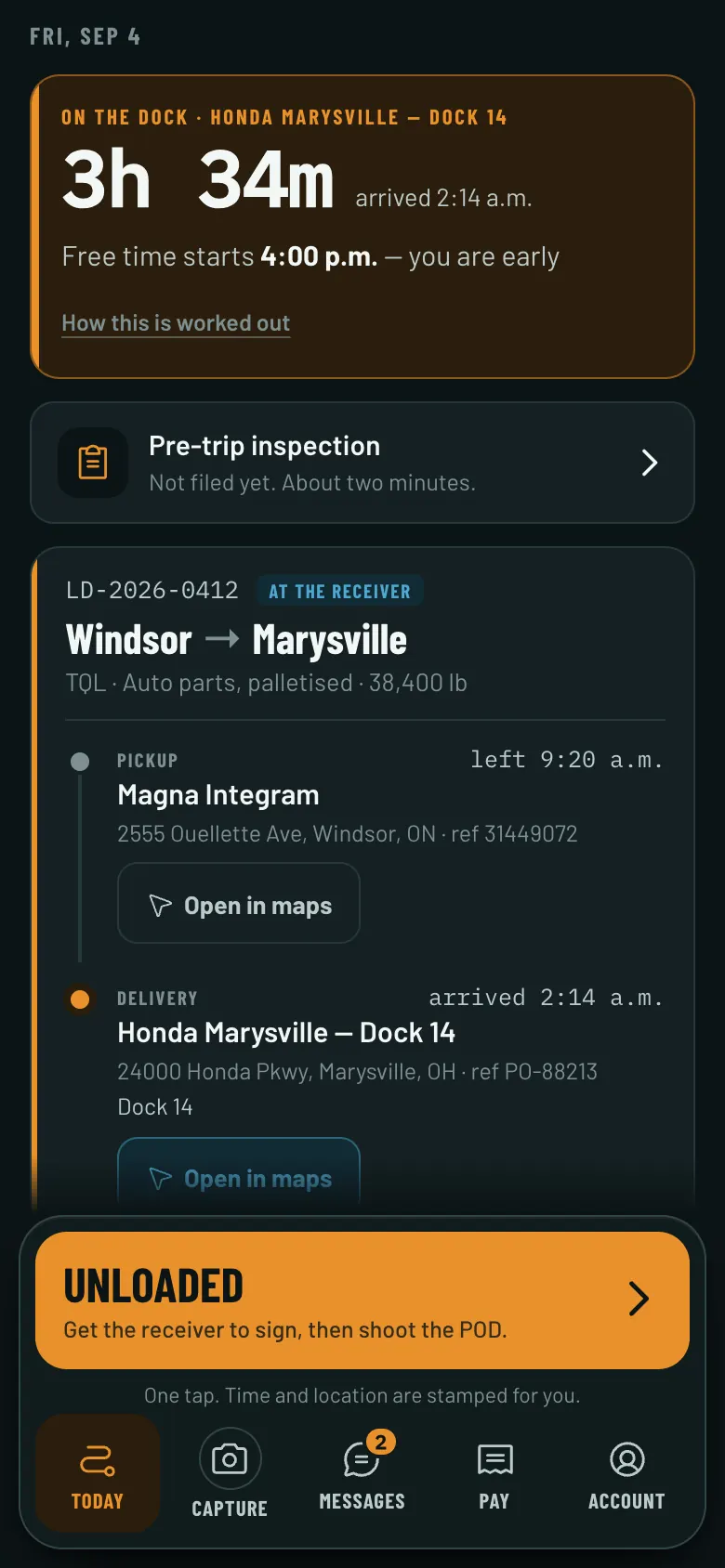
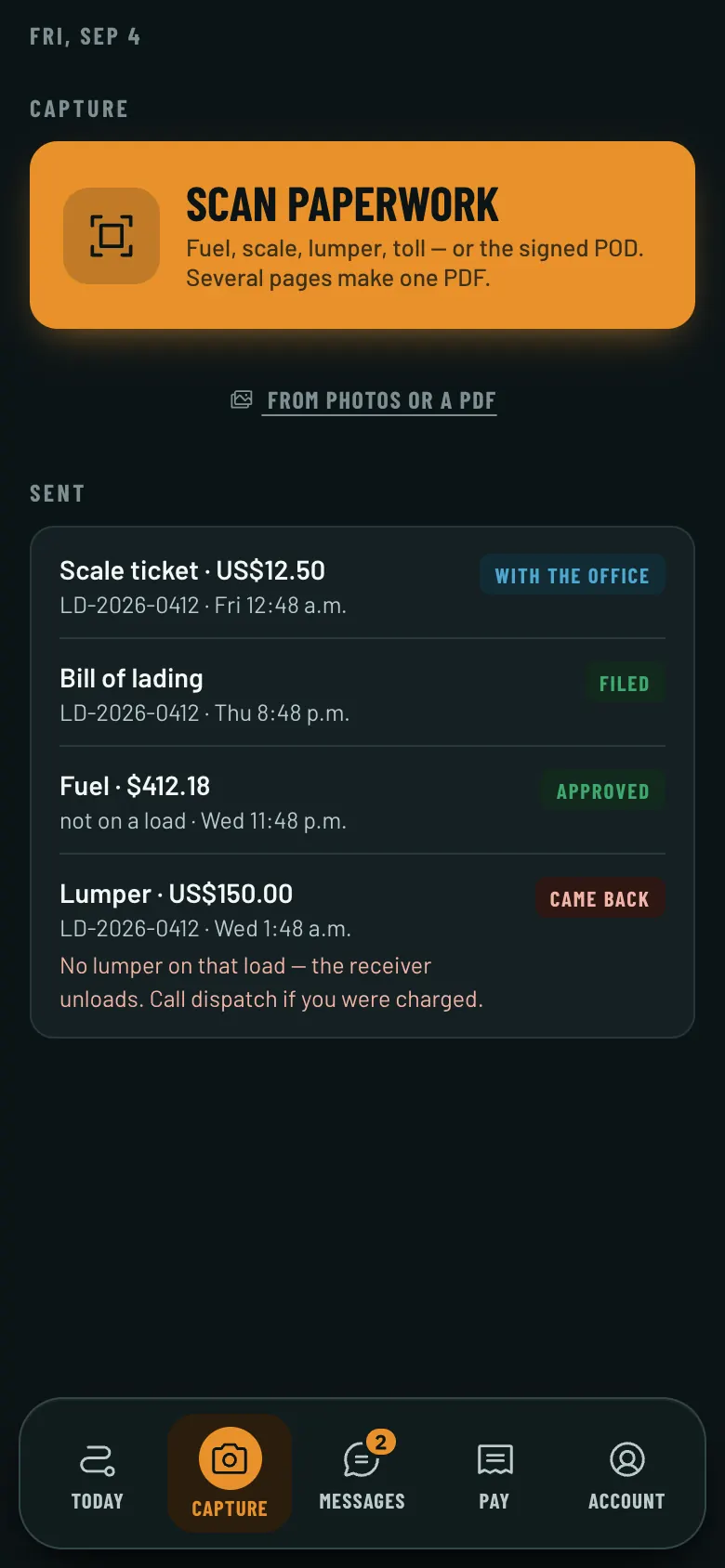
Not on day one. The driver app is also a web app: a driver opens a link, signs in with a code sent to their email, and is working. The iOS and Android builds are the same app with the camera and location plumbed in, and they are not in the app stores yet — the link is the way in today.
What happens to the spreadsheet we run on now?+
It is imported during onboarding — trucks, drivers, customers, pay rules, open loads. You do not start empty, and you do not type it all in yourself.
Can drivers see what a load pays?+
Never. A driver sees the stops, the times, the references, the instructions and their own pay. The rate is not in their app, not in their statement, and not in the data their account can reach.
What does the software do on its own?+
It reads documents into drafts, builds statements, watches the clocks, sends the briefing and answers questions about your own records. It does not book a load, send an invoice, approve a settlement or file with customs. Those are buttons, and a person presses them.
Does our data go to an AI company?+
The documents you hand the reader do: a rate confirmation, a receipt or a delivery document goes whole to the model and comes back as a draft somebody checks. A question you type goes as the sentence you typed and nothing else — no load, no rate, no customer and no row of your database is ever sent to a model, because the model’s only job is to pick which report answers you. The answer is then read out of your own database by the same code these screens run. Every provider is named on our sub-processor page.
Where is our data?+
The database and the files in it are in Canada, and each carrier’s rows are walled off from every other carrier’s by the database itself, not by the application. The software that serves it runs on a network outside Canada, and document reading, email, billing, sign-in and second-factor codes are done by providers outside it. Every one of them is named on our sub-processor page, with the one job it does. Your own data is yours to take out.
How long does onboarding take?+
Onboarding is built to have you dispatching in the first week and running a settlement at the end of it. What it costs is estimated for your fleet rather than listed, on every plan, because it pays for our hours that week and those depend on what you bring — a fleet of thirty with clean records is not the same week as a fleet of two hundred with none, and four trucks off a spreadsheet is often no week at all, in which case it is waived. Whatever the figure, it is agreed with you before anything is charged.